


US President Donald Trump’s threat to cut off the supply of chips and processors to Huawei Technologies Co is hitting China’s biggest tech company where it hurts – its dependence on other nations for the semiconductors and software used in smartphones and networking gear. So when China’s President Xi Jinping showed up days later at a rare earths processing plant, many observers saw a message in the visit: the US has its own tech vulnerabilities, too.
1. What are rare earths?
A group of 17 chemically related elements found in mineral form that have magnetic and optical properties useful for making electronics more efficient. Electric vehicle makers rely on them for lighter-weight battery and motor components, while large wind turbines tend to use rare-earth-based magnets. They’re also frequent components of everyday objects like light-emitting diodes, or LEDs, used to light up smartphones and stadium scoreboards.
2. How rare are they?
Not as rare as other precious metals such as gold or silver. But they’re usually so intermixed with other minerals as to make their extraction and refinement costly, particularly when the mining conforms to the environmental standards of developed countries. Rare earths include elements such as neodymium, used in magnets, and ytrrium, used for electronics.
3. Who controls them?
China and parts of Southeast Asia dominate both the mining and processing of rare earths. China accounted for 71% of the rare earths mined globally in 2018, according to the US Geological Survey. Australia and the US were distant runners up, together producing less than a third of China’s 120,000 metric tonnes. The US relied on China for about four of every five tons of rare earths imports between 2014 and 2017 and in 2018 purchased $160mn-worth, up 17% from a year earlier. Outside of China, the world’s other large reserves of rare earths can be found in Brazil, Vietnam and Russia. A slump in prices in recent years has made opening up new sources unappealing.
4. What role have rare earths played in the trade war?
Not much so far. Trump exempted US imports of rare earths from the round of tariffs on Chinese goods announced in May, after including them in a previous round. China included rare earths in a batch of tariffs on American imports that it raised to 25% from 10% in retaliation. A California company called MP Materials, the only US rare earths producer, sells much of its ore to China. The chief executive of its majority owner said “it is accurate to call this a targeted, unilateral tariff.”
5. What’s the message from China?
After Xi and his top trade negotiator, Vice Premier Liu He, visited a rare earths facility on May 20, analysts speculated that the strategic materials could be weaponised as trade tensions escalate. Then came a salvo of tough talk in Chinese media including the flagship People’s Daily on May 29, which included a rarely used, loaded phrase that means “Don’t say I didn’t warn you.” It wouldn’t be the first time China has restricted trade in rare earths. In 2010 Japanese officials charged that China had stopped exports to Japan during a maritime dispute. China denied there was any ban, which reportedly ended after a few weeks. But for 15 years, China imposed limits on rare-earth exports, citing a need to cut pollution and conserve supplies. Those quotas were scrapped in 2015, after the World Trade Organisation determined that they violated trade rules.
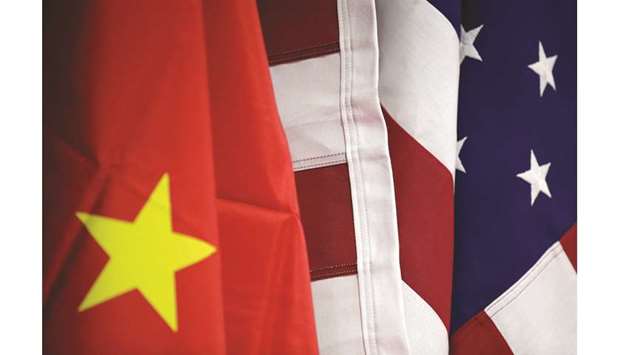
Flags of US and China are displayed at the American International Chamber of Commerce booth during the China International Fair for Trade in Services in Beijing on Tuesday. The US relied on China for about four of every five tonnes of rare-earths imports between 2014 and 2017 and in 2018 purchased $160mn-worth, up 17% from a year earlier.