


A landmark judgment at the High Court has found that the Home Office’s £1,012 child citizenship fee is unlawful.
The fee has been described as “shameless profiteering” by Amnesty International.
The current fee affect tens of thousands of children in the UK.
The Project for the Registration of Children as British Citizens (PRCBC), which brought the case, along with two children affected by the high fees, estimates there to be around 120,000 children in the UK without British citizenship, approximately 65,000 of whom were born here.
In 2018, more than 40,000 children applied to be registered as British citizens.
According to the Home Office, the cost of processing a child citizenship application is just £372 so the department makes a profit of £640 on the registration of each child.
This surplus is used to fund other parts of the Home Office’s immigration work.
The families of many children who have the right to be registered as British citizens, having been born in the UK and lived here for their first 10 years of their lives, simply cannot afford the high cost of registration, so thousands are condemned to live in limbo.
The court found a “mass of evidence” showing that the fee prevents many children from registering British citizenship, leaving them feeling “alienated, excluded, ‘second-best’, insecure and not fully assimilated into the culture and social fabric of the UK”.
The judgment requires the Home Office to reconsider the fee and ensure that children’s best interests are taken fully into account in doing so.
The court has made clear that where a child has a right to British citizenship it will generally be in the child’s best interests to be registered as British.
The case, challenging the lawfulness of the profit element of the Home Office’s £1,012 fee for a child to register as a British citizen and the lawfulness of charging a fee where a child cannot afford to pay it, was heard by Mr Justice Jay in the High Court last month.
The two children, known as A and O, both of whom were born in the UK, brought the challenge with the PRCBC, supported by Amnesty International UK.
Mishcon de Reya provided pro bono support to the PRCBC.
Before the British Nationality Act 1981, anyone born in the UK was born British.
The act ended this.
Since this legislation came into force, someone born in the UK is only a British citizen if one of their parents is either a British citizen or is settled in the UK.
The main rights for children to register as British citizens under the act are intended to mitigate the ending of automatic citizenship by birth so that all children born and growing up in the UK are equally recognised as British citizens.
The PRCBC says that the harm done to children if they are unable to register as British citizens are similar to those suffered by people of the Windrush generation – damage to children’s identity and to their sense of belonging and security.
The harm can also cross generations.
A child unable to register as a British citizen may later be the parent of a child who for that reason is not born British.
Children who are not British citizens may be at risk of being removed from the United Kingdom.
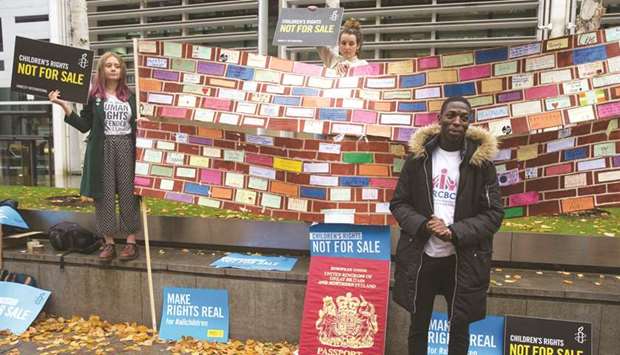
Campaigners from Amnesty International UK’s Children’s Human Rights Network and PRCBC outside the Home Office to call on the government to stop selling children’s rights.