


The US trade deficit dropped for the first time in six years in 2019 as the White House’s trade war with China curbed the import bill, helping the economy to continue growing moderately in the fourth quarter despite a slowdown in consumer spending.
The Commerce Department said on Wednesday the trade deficit fell 1.7% to $616.8bn last year, the first drop since 2013.
Goods imports tumbled 1.7% last year, with exports decreasing 1.3%, showing that the Trump administration’s “America First” agenda decreased the flow of goods.
Goods imports, however, rebounded sharply in December, boosting the trade deficit 11.9% to $48.9bn that month. Data for November was revised to show the gap tightening to $43.7bn instead of $43.1bn as previously reported.
Economists polled by Reuters had forecast the trade gap would widen to $48.2bn in December.
President Donald Trump, who has dubbed himself “the tariff man,” pledged on both the campaign trail and as president to reduce the deficit by shutting out more unfairly traded imports and renegotiating free trade agreements.
At the height of the US-China trade war last year, Washington slapped tariffs on billions worth of Chinese goods, including consumer products, leading to a decline in imports.
Tensions in the 19-month US-China trade war have eased, with Washington and Beijing signing a Phase 1 trade deal last month.
The deal, however, left in place US tariffs on $360bn of Chinese imports, about two-thirds of the total.
The White House has also sparred with other trading partners, including the European Union, Brazil and Argentina, accusing them of devaluing their currencies at the expense of US manufacturers.
The politically sensitive goods trade deficit with China fell 6.0% to $24.8bn in December, with imports shrinking 7.7% and exports falling 12.2%. It tumbled 17.6% to $345.6bn in 2019.
But the goods trade deficit with Mexico jumped to a record high of $101.8bn last year.
The deficit with the European Union also reached an all-time high of $177.9bn.
When adjusted for inflation, the goods trade deficit increased $4.3bn to $80.5bn in December.
Trade added almost 1.5 percentage points to GDP growth in the fourth quarter, exceeding the 1.20 percentage points contribution from consumer spending, which accounts for more than two-thirds of US economic activity.
The economy grew at a 2.1% annualised rate in the fourth quarter, matching the pace notched in the July-September period.
It expanded 2.3% in 2019, which was the slowest in three years, after growing 2.9% in 2018.
In December, goods imports surged 3.2% to a seven-month high of $207.5bn, after declining for three straight months.
Goods imports were boosted by a $1.7bn increase in crude oil imports, which contributed to a $4.0bn jump in imports of industrial supplies and materials.
There was also a $1.2bn increase in imports of other goods.
Economists believe a 15% tariff on $110bn worth of Chinese goods that came into effect on September 1 had weighed on imports in the prior months.
They also say anticipation that the Phase 1 trade agreement would roll back the tariffs could have encouraged companies to hold off on imports in late 2019.
Goods exports rose 0.9% to $137.7bn in December.
They were lifted by a $1.5bn jump in shipments of crude oil as well as a $1.0bn increase in exports of other goods.
But motor vehicle and parts exports fell $1.0bn to $12.4bn, the lowest since November 2016.
At $17.1bn, petroleum exports in December were the highest on record.
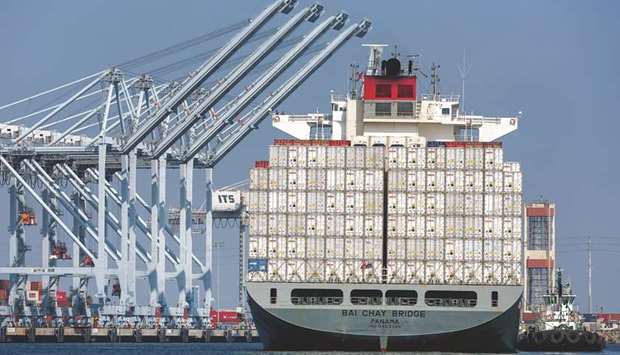
A tugboat guides a cargo ship into the Port of Long Beach in California. The US Commerce Department said on Wednesday the trade deficit fell 1.7% to $616.8bn last year, the first drop since 2013.