


HE the Special Adviser to the Secretary-General of the United Nations Dr Ahmed bin Mohamed al-Muraikhi has affirmed the strength of relations between Qatar and United Nations organisations and agencies, pointing out that these relationships are strong and distinguished.
In an interview with Qatar News Agency, al-Muraikhi noted the opening of the representative offices of various UN agencies in Doha, the most recent of which was the opening of the International Hub on Behavioural Insights to Counter Terrorism, which was preceded by the opening of many centres and offices of the UN agencies in various fields.
He pointed out that Qatar’s hosting of representative offices of UN agencies, as well as the imminent opening of the United Nations House proves that Qatar is moving forward in strengthening multilateral relations. It also clearly reflects the state’s trend towards strengthening its regional and international position by affirming that it is a state sponsor of peace and that it places multilateral international co-operation among its priorities to enhance the efforts of achieving the UN development goals and efforts to combat terrorism.
Al-Muraikhi said the partnership involves other sectors such as educational institutions and the private sector.
In this context, he pointed to the co-operation between the UN and the Ministry of Foreign Affairs, Qatar University, and the Qatar National Commission for Education, Culture and Science to achieve a mechanism directed at school and university students of the younger generation with the aim of introducing them to the mechanisms of UN action and qualifying them to work within UN organisations by involving them in the international meetings held inside and outside Qatar, visiting the centres of UN organisations and refugee camps and closely introducing them to the methods of international action and raising their awareness about those methods.
He also referred to the co-operation with the Ministry of Commerce, the Qatar Financial Centre, and the Qatar Chamber of Commerce to create a partnership between the Qatari private sector and UN organisations as a series of introductory sessions will be held, targeting the Qatari private sector related to how to establish a constructive partnership between it and the UN organisations to reach a form of co-operation to create an effective presence of the Qatari private sector on the international arena.
Al-Muraikhi touched on the initiative launched within the International Alliance for Humanitarian Action, related to the importance of engaging the private sector worldwide with UN agencies and building bridges of co-operation between them in order to resolve many issues and achieve the seventeen goals of sustainable development.
He dilated on the initiative that was put forward at the World Humanitarian Summit in Istanbul, Turkey, related to strengthening the mechanisms of humanitarian work and making use of Islamic financing tools such as Zakat, charity, endowments, and others with the aim of achieving a shift that contributes to meeting humanitarian.
He pointed out that the largest proportion of the humanitarian needs are concentrated in the Islamic world, specifically in the Middle East. By looking at the estimates of Zakat in the Islamic world, it turns out that they range from $300-600 billion, which highlights the importance of finding a mechanism to fill the need gap through that initiative.
Al-Muraikhi said that according to the UN Humanitarian Action Plan announced in early December, there are 56 affected countries, and 235 million affected people. With the increasing needs, $35 billion is needed to achieve the minimum of their needs, and it is necessary to create new and effective methods, take advantage of the mechanisms they have, and try to adapt them to meet those needs.
He explained that humanitarian work faces difficulties with regard to the safety of the transfer of funds from internal to external, indicating that the initiative will create safe, transparent and observed channels, which requires extensive study and opinions of specialists in all areas related to Islamic and international finance, adding that this issue will be raised during the World Islamic Economic Forum (WIEF) in Doha and taken into consideration.
On the protection of humanitarian work from political vicissitudes as sports have achieved in terms of being separated from politics, al-Muraikhi pointed out that it is necessary not to involve politics and its vicissitudes in humanitarian work, adding that although challenging, he is convinced that in many countries, solutions to humanitarian problems can never be found without a political solution.
He also felt that in conflict situations, humanitarian work faces a difficulty in that it deals with multiple parties that are not connected with the state and not subject to international law, unlike in sports where parties are official governments or governmental organisations and bodies that are subject to international law and UN resolutions.
He stressed the importance of multilateral co-operation, considering it one of the most significant development goals of the UN as it creates a multilateral partnership between states and UN organisations, referring to Qatar’s role as an example of the co-operation’s significance as it succeeded in achieving significant growth in its international relations and worked diligently to strengthen and develop them, which is embodied in the Qatari contribution and the active role that Qatar plays in the international system. Qatar donated $500 million to support the basic resources for UN organisations, and another $63 million, which was announced during the Doha Forum activities.
He pointed to the response of the UN organisations to the effective Qatari efforts in the international community, which proves Qatar’s progress in achieving its national vision 2030, through its endeavours to achieve international security and peace as well as multilateral co-operation.
He said that these endeavours resulted in Qatar assuming a prominent position regionally and internationally, and currently the country heads the donor group at the UN, as well as being one of the major donors. Moreover, Qatar’s presence at the centre of international decision-making contributes to increasing the world’s understanding of the region, and this also plays an important role in co-ordinating it in the implementation of humanitarian aid.
With regard to the issue of refugees and efforts to provide safe areas for their return, the Special Adviser to the UN Secretary-General stressed that the return of refugees and the resolving of the asylum file represent a major challenge for all active states and international and humanitarian organisations.
He cited the peace process in Afghanistan and Qatar’s great efforts in the success of the process to bring peace to that country, affirming that these efforts have demonstrated the ability of countries to create influence and achieve peace. He noted the firm position of Qatar, and its belief in the principle of dialogue and sitting at the dialogue table.
About the South-South co-operation file, al-Muraikhi explained that it is one of the files that he worked on as commissioned by the UN Secretary-General, pointing out that most of the countries of the South are countries in need of assistance. Accordingly “South-South” co-operation has been established for encouraging mutual co-operation between the countries of the South and achieving an exchange of experiences, in addition, to shedding light on the co-operation of Arab countries among them, he said. To achieve this, an office at the UN under the UNDP was founded and it is concerned with how to achieve co-operation between countries of the South.
He touched on the importance of South-South co-operation by developing co-operation mechanisms and finding appropriate solutions, stressing that the meetings, seminars and activities that were held to achieve co-operation resulted in establishing communication between the concerned countries and creating joint co-ordination, which is what was done between the State of Kuwait and the Kingdom of Jordan as part of the initiative to form a model that can be developed to be emulated in the future.
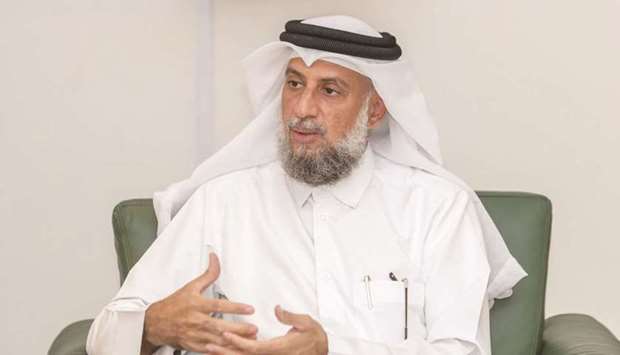
COMMITTED: HE the Special Adviser to the UN Secretary-General Dr Ahmed bin Mohamed al-Muraikhi.