


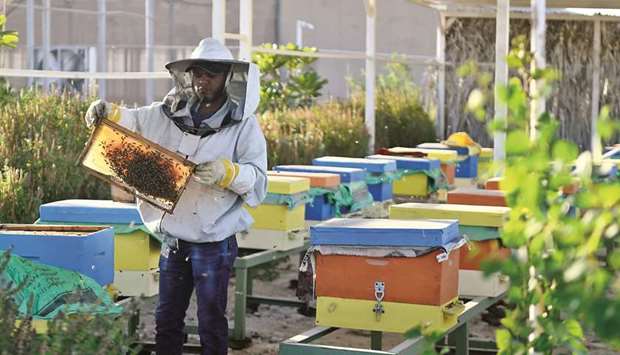

While demanding steps to increase honey production in Qatar, farmers have urged the Ministry of Municipality and Environment (MME) to chalk out a comprehensive plan that will help them.
Engineer Abdul Rahman al-Obaidan, vice chairman of the board of directors of Al-Waha Farm, told local Arabic daily Arrayah that farmers are facing multiple challenges and the MME should put forward a plan to help them address these woes in order to increase honey production and ensure proper marketing.
“The honey and beekeeping sector is not a stand-alone sector, but rather a supportive sector for the agricultural sector. Therefore, most farms have beehives that are harvested thrice per season and farmers are looking to increase the production. They are facing various challenges, including ensuring proper prices for summer produce of fruits that are cultivated to support honey production,” al-Obaidan said.
“We plant a number of trees that bees feed on in preparation for increasing the number of beehives from 50 to 100. We planted cantaloupe in four greenhouses covering an area of 32,000sq m to feed the bees in summer. But we found after the feasibility study that the current prices for honey will not cover production costs,” he explained.
Al-Waha Farm, according to him, has 50 beehives that produce 350kg honey per season and it’s planning to increase the number of beehives to 100 next season and then to 200 within three years to produce 1,400kg honey per season.
“We are looking to establish a department for bees and honey production in the farm and are constantly working on developing it. We started with four hives, increased them to eight until reaching 50 this season. Besides, we are currently working on supplying beehives for home gardens to produce honey and we follow up from the beginning to the production,” he said.
Al-Obaidan observed there are great difficulties in importing bees.
The process of shipping bees and getting customs clearance takes between seven to 10 hours. "This results in the death of some bees while the rest are left in a state of fatigue. The process is long and it needs to be resolved,” he said.
Establishing bee-breeding nurseries in Qatar, similar to those in Europe, is the only solution in his opinion, in this regard.
“The absence of packaging facilities and laboratories for honey analysis is another challenge. The analysis of honey gives the farm owner a classification for his product and a certificate that is printed on the product indicating that it is of high quality and this encourages the consumer,” he explained.
“The honey and beekeeping sector is not a stand-alone sector, but rather a supportive sector for the agricultural sector. Therefore, most farms have beehives that are harvested thrice per season and farmers are looking to increase the production. They are facing various challenges, including ensuring proper prices for summer produce of fruits that are cultivated to support honey production,” al-Obaidan said.
“We plant a number of trees that bees feed on in preparation for increasing the number of beehives from 50 to 100. We planted cantaloupe in four greenhouses covering an area of 32,000sq m to feed the bees in summer. But we found after the feasibility study that the current prices for honey will not cover production costs,” he explained.
Al-Waha Farm, according to him, has 50 beehives that produce 350kg honey per season and it’s planning to increase the number of beehives to 100 next season and then to 200 within three years to produce 1,400kg honey per season.
“We are looking to establish a department for bees and honey production in the farm and are constantly working on developing it. We started with four hives, increased them to eight until reaching 50 this season. Besides, we are currently working on supplying beehives for home gardens to produce honey and we follow up from the beginning to the production,” he said.
Al-Obaidan observed there are great difficulties in importing bees.
The process of shipping bees and getting customs clearance takes between seven to 10 hours. "This results in the death of some bees while the rest are left in a state of fatigue. The process is long and it needs to be resolved,” he said.
Establishing bee-breeding nurseries in Qatar, similar to those in Europe, is the only solution in his opinion, in this regard.
“The absence of packaging facilities and laboratories for honey analysis is another challenge. The analysis of honey gives the farm owner a classification for his product and a certificate that is printed on the product indicating that it is of high quality and this encourages the consumer,” he explained.