


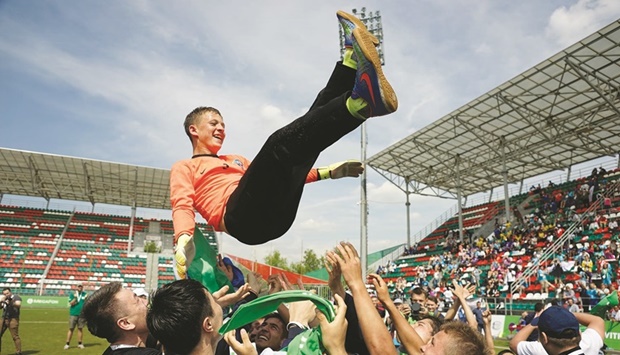
Young football teams from around the globe representing some of the world’s most vulnerable children will gather in Qatar next month to participate in a sporting tournament with a call for change – the fourth edition of the Street Child World Cup, in partnership with Qatar Foundation (QF).
The sport-for-good event will combine a 25-country, 28-team football tournament, a festival of art, and a child-friendly congress to champion resilient young people who face significant adversity living in street situations. It will be a platform for children to put forward their demands for a more equal and fair existence.
Taking place at QF’s Education City from October 8 to 15, the Street Child World Cup will feature 15 boys’ teams and 13 girls’ teams, with 10 of the teams being represented by refugees or displaced children.
“The Street Child World Cup was created to give street-connected children a voice to tell the world ‘I am somebody’,” said John Wroe, co-founder and CEO of the event organiser Street Child United, the UK charity that uses the power of sport, and particularly international sports events, to change negative perceptions and treatment of street-connected children.
“The UN estimates there to be over 100mn children living on the streets worldwide. These are children without any formal identification; without legal rights; without access to education; and without access to healthcare. The Street Child World Cup aims to change this.
“By having the world’s attention on Qatar ahead of the FIFA World Cup Qatar 2022, we can demonstrate the power of football for social good; helping to educate and raise awareness of these children’s circumstances. Together we can create necessary change so that no child, anywhere, is living or sleeping on the streets,” Wroe said.
The football component of the event will be delivered in a similar format to that of the FIFA World Cup, with an official draw on October 8 where the teams will be presented with their kits for the tournament. Following training sessions, the group stages kick off on Tuesday, October 11, culminating in the finals on October 15. The competition will be hosted at Oxygen Park in Education City, and is open to the public to come and support the teams.
Samuel de Souza, a player from the Brazil boys’ team, said: “For me, it will be a new experience – my first travel outside the country. I feel very proud to represent the street children of Brazil, especially the kids in Fortaleza.”
The countries represented in the tournament will be Bangladesh, Bolivia, Bosnia and Herzegovina, Brazil, Burundi, Colombia, Egypt, England, Hungary, India, Indonesia, Mauritius, Mexico, Nepal, Palestine, Pakistan, Peru, Philippines, Qatar, Sudan, Syrian Forum, Tanzania, Uganda, US, and Zimbabwe.
Alongside the football, participants will also be involved in an arts programme, with Qatari artist Maryam Faraj al-Suwaidi working with the children on the theme of identity and helping them to create layered self-portraits through collage work and painting workshops.
The pieces created will be showcased at an exhibition hosted by Katara – Cultural Village on October 14, alongside the work of other artists joining the Street Child World Cup delegation.
“The Street Child World Cup is a true cultural exchange,” said Beatrice Garcia, arts manager at Street Child United. “There is a lot of colour and magic that accompanies a Street Child World Cup, and it will be incredibly special to see it all come to life through the medium of art.”
Both football and art support the centrepiece of the Street Child World Cup: the General Assembly. Hosted before the finals on October 15, it is a platform where the young people will present their voices to the world.
The demands made at the General Assembly will be shaped by discussions from child-friendly Congress sessions hosted throughout the week. The findings, along with inputs of Street Child United young leaders, will be compiled into a formal document, The Qatar Commitment’, a collective pledge to help advance the lives of children living in street situations.
Leaders of Street Child World Cup partner organisations will be invited to sign the pledge alongside representatives of the Street Child World Cup, before it is shared digitally for the rest of the world to endorse.
The Qatar Commitment is one of a number of legacy initiatives focused on education and healthcare that will start at the Street Child World Cup, aimed at continuing to make positive change around the world in the months that follow the tournament.
Taking place at QF’s Education City from October 8 to 15, the Street Child World Cup will feature 15 boys’ teams and 13 girls’ teams, with 10 of the teams being represented by refugees or displaced children.
“The Street Child World Cup was created to give street-connected children a voice to tell the world ‘I am somebody’,” said John Wroe, co-founder and CEO of the event organiser Street Child United, the UK charity that uses the power of sport, and particularly international sports events, to change negative perceptions and treatment of street-connected children.
“The UN estimates there to be over 100mn children living on the streets worldwide. These are children without any formal identification; without legal rights; without access to education; and without access to healthcare. The Street Child World Cup aims to change this.
“By having the world’s attention on Qatar ahead of the FIFA World Cup Qatar 2022, we can demonstrate the power of football for social good; helping to educate and raise awareness of these children’s circumstances. Together we can create necessary change so that no child, anywhere, is living or sleeping on the streets,” Wroe said.
The football component of the event will be delivered in a similar format to that of the FIFA World Cup, with an official draw on October 8 where the teams will be presented with their kits for the tournament. Following training sessions, the group stages kick off on Tuesday, October 11, culminating in the finals on October 15. The competition will be hosted at Oxygen Park in Education City, and is open to the public to come and support the teams.
Samuel de Souza, a player from the Brazil boys’ team, said: “For me, it will be a new experience – my first travel outside the country. I feel very proud to represent the street children of Brazil, especially the kids in Fortaleza.”
The countries represented in the tournament will be Bangladesh, Bolivia, Bosnia and Herzegovina, Brazil, Burundi, Colombia, Egypt, England, Hungary, India, Indonesia, Mauritius, Mexico, Nepal, Palestine, Pakistan, Peru, Philippines, Qatar, Sudan, Syrian Forum, Tanzania, Uganda, US, and Zimbabwe.
Alongside the football, participants will also be involved in an arts programme, with Qatari artist Maryam Faraj al-Suwaidi working with the children on the theme of identity and helping them to create layered self-portraits through collage work and painting workshops.
The pieces created will be showcased at an exhibition hosted by Katara – Cultural Village on October 14, alongside the work of other artists joining the Street Child World Cup delegation.
“The Street Child World Cup is a true cultural exchange,” said Beatrice Garcia, arts manager at Street Child United. “There is a lot of colour and magic that accompanies a Street Child World Cup, and it will be incredibly special to see it all come to life through the medium of art.”
Both football and art support the centrepiece of the Street Child World Cup: the General Assembly. Hosted before the finals on October 15, it is a platform where the young people will present their voices to the world.
The demands made at the General Assembly will be shaped by discussions from child-friendly Congress sessions hosted throughout the week. The findings, along with inputs of Street Child United young leaders, will be compiled into a formal document, The Qatar Commitment’, a collective pledge to help advance the lives of children living in street situations.
Leaders of Street Child World Cup partner organisations will be invited to sign the pledge alongside representatives of the Street Child World Cup, before it is shared digitally for the rest of the world to endorse.
The Qatar Commitment is one of a number of legacy initiatives focused on education and healthcare that will start at the Street Child World Cup, aimed at continuing to make positive change around the world in the months that follow the tournament.