


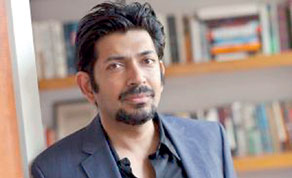
IANS/Washington
 Indian American cancer specialist Siddhartha Mukherjee has bagged this year’s Pulitzer prize in the general non-fiction category for his book The Emperor of All Maladies: A Biography of Cancer.
Delhi-born Mukherjee’s book has been described as “an elegant inquiry, at once clinical and personal, into the long history of an insidious disease that, despite treatment breakthroughs, still bedevils medical science.”
The finalists in the category were The Shallows: What the Internet Is Doing to Our Brain by Nicholas Carr and Empire of the Summer Moon: Quanah Parker and the Rise and Fall of the Comanches, the Most Powerful Indian Tribe in American History by S C Gwynne.
An assistant professor of medicine at Columbia University and a staff cancer physician at Columbia University Medical Center, Mukherjee had said in December last year: “Cancer is growing dramatically in certain parts of South Asia.”
Mukherjee advocated a strong anti-smoking campaign and breast cancer screening to battle the growing incidence of the disease in India.
Less than a month after its publication, Mukherjee’s book featured among “The 10 Best Books of 2010” in the New York Times Book Reviews, a rare feat for a work of non-fiction.
The doctor linked increase in cancer cases to tobacco smoking.
“But there are other culprits too,” he said. “As the population ages and other diseases are slowly eliminated, cancer begins to come about.”
“Cancer rises in the double negative only when all the other killers have been killed. So I think that’s beginning to occur in some parts of South Asia.”
Mukherjee, 40, who grew up in New Delhi’s Safdarjung Enclave, “immersed in reading and books” at home and studied at St Columba’s School, says he “came into oncology in a sort of reverse, in the sense that I first trained as a cellular biologist when I was in Oxford as a Rhodes scholar.”
“So I really came from the cell into medicine. Many people first train in medicine, then eventually get fascinated by cells.”
The book isn’t meant for the medical profession alone, he said. “The target is everyone. The point of this book was to make this world of medicine and science and culture accessible to anyone who is interested,” Mukherjee said.
Meanwhile his mother said when Mukherjee called her mother at 1am yesterday to say he had won the Pulitzer, she thought he was pulling a fast one!
“It came as a complete surprise. Siddhartha called us at 1 and asked if we were awake. I said of course not - senior citizens don’t stay up so late. Then he told me that he has won this prize and I just couldn’t believe it,” Mukherjee’s mother Chandana, who lives in Delhi, said.
She said they have been flooded with calls after the news broke. “There have been a lot of calls.”
Mukherjee’s wife, Sarah Sze, is a sculptor. He has two daughters - Leela, aged five-and-a-half, and Arya, who is just over a year old.
“Leela is very shy and doesn’t like to speak on the phone. But the family is obviously very excited,” the grandmother said.
Mukherjee’s sister is married and lives in Dhaka.
Mukherjee is an assistant professor of medicine at Columbia University and a cancer physician at the CU/NYU Presbyterian Hospital.