


DPA/New Delhi
 |
|
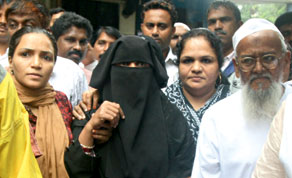
Rohida Faiz Usmani (C), widow of Faiz Usmani, is seen outside a hospital after her husband’s death |
Faiz Usmani was taken to a hospital by police after he took ill during interrogation Saturday, but he died early yesterday, IANS news agency reported.
Usmani’s family said he was healthy when the police picked him up and alleged he had been tortured, Times Now television reported.
Usmani is the brother of an accused in the Ahmedabad bomb blasts of 2008, Afzal Usmani, who is currently held in a jail in Gujarat state.
“I want justice. I want a probe into my husband’s death,” Usmani’s wife Rubeda was quoted as saying. She said her husband had been healthy when he was detained.
Mumbai police rejected the allegation.
“He (Usmani) was brought to the crime unit for questioning. There is no question of torture,” Mumbai deputy commissioner of police Nisar Tamboli said.
The police officer said Usmani collapsed after two hours of questioning and was rushed to the hospital and his family was informed. Usmani was found to have been suffering from high blood pressure.
“We can wait for the autopsy report to come to a formal conclusion,” Tamboli said.
“We conducted all tests on the patient and it was a case of a massive haemorrhage,” IANS news agency quoted a medical official at Sion Hospital as saying. The official said when Usmani was brought in his blood pressure exceeded 220 points and there was a large amount of blood in his brain.
The Maharashtra Police chief Ajit Parasnis has ordered a probe into Usmani’s death. Mumbai is capital of Maharashtra state.
The number of deaths in police custody has been on the rise over the years, according a 2010 report by the New Delhi-based Asian centre for Human Rights (ACHR).
The ACHR’ report suggests that police detainees are at highest risk of torture in the first 24 hours after being picked up. The lack of independent monitoring systems at places of detention facilitates torture, the report added.
According to India’s National Human Rights Commission, at least 107 people died in police custody in 2010.
A Prevention of Torture Bill which provides for punishment for those involved in torture was passed by the lower house of parliament in 2010, but is still pending in the upper house.
The latest terror bombings that ripped through India’s financial and entertainment capital have shifted the focus back on the much-awaited police reforms and the absence of preventive intelligence gathering in India.
Reforms would mean doing away with the colonial legacy in the form of the archaic Police Act of 1861, if the nation is to be saved from terrorist outfits and homegrown subversive elements, say experts working on bringing about these changes. The blasts have again exposed known flaws in India’s internal security structure allowing a silent growth of homegrown terrorists, experts say.
The main problems India faces are the vacancies in police forces and inadequate training of force personnel. These problems are only aggravated by the poor intelligence gathering model.
According to official figures, India’s police-population ratio is just 120 per 100,000 people. Globally the ratio is an average of 270.
India has over 20 big and small central intelligence and security agencies - including the Intelligence Bureau (IB), the Central Bureau of Investigation (CBI) and the National Investigation Agency (NIA) - apart from state police intelligence wings.
India’s capacity to repel a terror attack may have improved but the country still lacks the ability to pre-empt such strikes, experts say. Ground-level intelligence gathering is too poor to prevent modern threats.
When Ajai Sahni, a known security expert, was asked if he thought there are chinks in India’s security establishment, he quipped: “There are gaps, enormous gaps.
“Can you believe that India’s main internal spy agency, the IB, has less than 5,000 field agents to gather ground information from a population of 1.2bn?” Sahni told IANS.
“And their primary job is to do political intelligence for the ruling parties.”
Police officer-turned-activist Kiran Bedi has a question for the government, particularly the union home ministry that looks after internal security management.
“How much did the Indian police forces reinvent themselves after the (2008) terror attack in Mumbai? You are managing a crisis by creating these intelligence agencies, not preventing a crisis. How will you prevent terrorism in the absence of a trained policeman who is your eyes and ears on the ground?”
Bedi said that if normal policing “is absent and you don’t have people on the ground to collect information, these things can happen”.
Sahni, who runs the Institute for Conflict Management that focuses on internal security research in India, said if ground-level intelligence gathering was there, then of course “we wouldn’t have taken so long to know who did the Mumbai blasts again”.
“Haven’t we identified the subversive elements that need constant surveillance? If so, how do we allow them to grow and strike again?”
He recalled an old intelligence gathering system in the country of having a watchman in every village. Those village watchmen used to report to intelligence officers at the local police station every day with whatever information they had.