


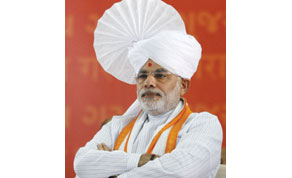
Agencies/Ahmedabad
 Gujarat Chief Minister Narendra Modi has come under attack after he refused to wear a skull cap offered by a Muslim cleric during his fast for amity in Ahmedabad.
Sayed Imam Shahi Saiyed had on Sunday gone up to the stage to greet the chief minister.
He offered Modi a skull cap, but the chief minister politely refused to wear it, asking him to offer a shawl instead. Modi accepted the shawl.
“Narendra Modi’s refusal to accept the cap is not my insult but an insult of Islam,” Saiyed told reporters.
“I had come to Ahmedabad after hearing about the sadbhavna (harmony) fast and went to the stage to felicitate Modi.
“When I offered him the cap he told me he would not wear it. He might have thought that wearing a skull cap will dent his image,,” the cleric said.
Modi’s Bharatiya Janata Party, however, said it was a non-issue.
“Narendra Modi has clearly said that his policy is not of appeasement of a section of the society unlike other parties, but our approach is development for all and treating everyone as equal,” party spokesperson Vijay Rupani said.
“Thousands of members of the minority community have come here, but nobody insisted that Narendra Modi put on a skull cap. This is a non-issue which is being turned into a big one by our opponents,” Rupani said.
Meanwhile, observers say though Modi may be eyeing the prime minister’s post with his three-day fast that ended yesterday, there are few takers for the view that he might be a contender for top job in 2014.
The BJP is helping build “brand Modi” but internal conflicts within the party send another message entirely about the leader, held responsible for the 2002 riots that killed more than 1,000 people, mostly Muslims, in his state. The sectarian violence and its aftermath still cast a dark shadow, making Modi unacceptable to many across the political spectrum despite his image as an able administrator.
“The BJP sees an opportunity in Modi. They are trying to build ‘brand Modi’, which depicts development, anti-corruption, and progress... However, the biggest challenge for Modi is to be able to deal with the 2002 riots, which are actually a blot on the nation’s secular fabric,” said Sandeep Shastri, pro-vice chancellor of Jain University and director, International Academy for Creative Teaching in Bangalore.
The BJP, while making a clear attempt to cash on the popularity, neither confirms nor denies the possibility of Modi being its prime ministerial candidate. The buzz had intensified after the US Congressional Research Service had said in a report that he could be in the reckoning for the post.
“The sadbhavna mission is not an exercise to project Modi as a prime ministerial candidate,” party leader Balbir Punj said. “All the same, he is definitely proven prime minister material.”
But tensions simmer below the surface of the official calm.
A highly placed source from the party said it was difficult to project Modi as the prime ministerial candidate as there were several other senior leaders who were averse to the idea.
“While it is true that Modi is popular with certain sections, and has large backing from the corporate class, it is difficult for him to be prime minister,” the source said.
Key National Democratic Alliance (NDA) partner Janata Dal-United has also made it abundantly clear that it does not endorse Modi or his politics.
“There is no chance for Modi to become the prime minister in 2014,” said Nisar ul Haz, head of the department of political science in Delhi’s Jamia Millia Islamia university.
“I think there will be a hard race for prime ministership within the BJP. L K Advani will not leave his claim so easily. There are lots of other contenders in the BJP like Sushma Swaraj, Arun Jaitley and seniors who will not allow Modi,” he added, stressing that the communal card would work against him.
Stop work on Koodankulam